
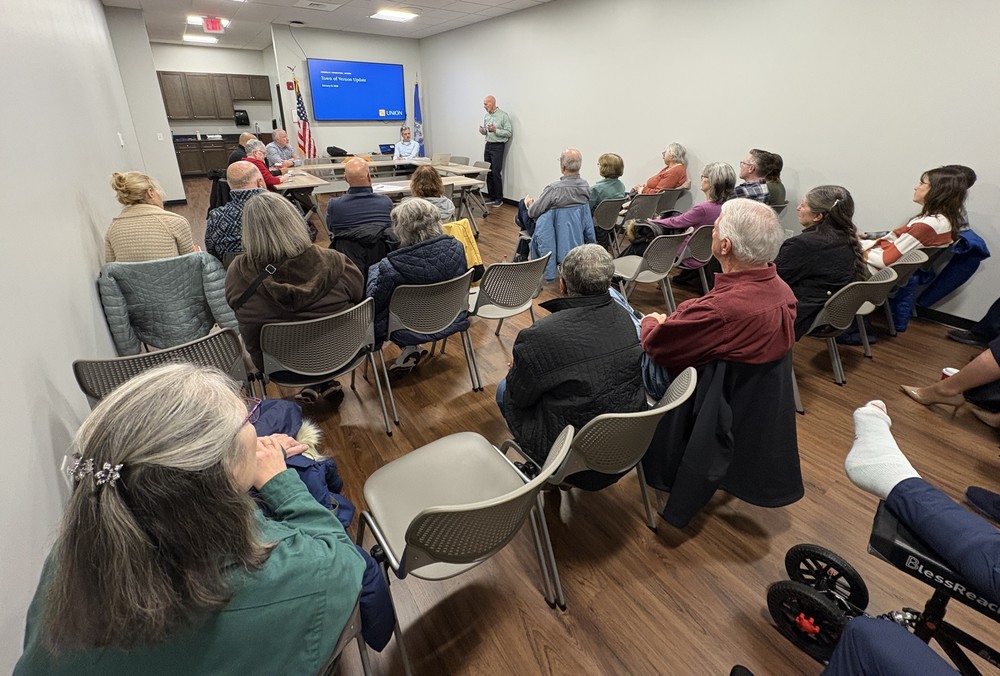
About 25 people filled the conference room at Citizens Block Tuesday evening for an update on the Vernon mills redevelopment program and several expressed optimism and excitement about the project’s potential to transform Rockville.
Shaun Gately, Vernon’s director of development services, briefed residents on the progress of the plan, the vision and the timeline. Joining him were Mayor Dan Champagne, Town Administrator John W. Kleinhans, Joe Haskett, an architect with Union Studios and a representative of the developer, Camden Management Partners of Atlanta, and David Ruszyk, a licensed environmental professional with GZA Environmental.
The project encompasses three mills: Amerbelle, Daniel’s and Anocoil. The Hockanum River, which once powered Rockville’s many mills, flows through the site and creates a mill pond before spilling over a waterfall.
Several residents expressed excitement about the project and its potential to be transformative for Rockville and Vernon. That has been Mayor Dan Champagne’s vision since he and town staff tackled the project more than nine years ago and sought grants to cleanup industrial contamination on the site and bring new life to the complex.
“These mills are the gateway to Rockville and this project will transform and further enhance our downtown,” Mayor Champagne said. “They represent an important part of Vernon’s history and my goal is to make them an important part of our future too. In the meantime, we continue to work with the state and federal government to help move this project forward.”
The focus now is remediating PCB contamination. Because of the planned residential use of the mills, the PCBs have to be removed. That has complicated and driven up the cost of the cleanup.
Contamination is particularly heavy in the Daniel’s Mill portion of the project, which was once home to a fireproof paint manufacturer.
Bestech Inc. of Ellington is performing remediation work in Daniel’s Mill. The wood beams that support the structure will have to be removed and replaced because they are contaminated.
The complicated work is important and necessary because historic preservation tax credits are a key component of the project’s financing, and for that reason the historic elements of the structures must be maintained or replicated.
The site plan for the mill complex calls for about 110,000 square feet of residential units, commercial space and parking. Walkways around the complex and mill pond are also planned.
“It’s an amazing project,” Haskett said. “It’s an unbelievable site.”
Mayor Champagne said a state grant the town applied for is expected to be awarded soon and he is hopeful the town will receive it.